
A turning point for North-East Asia’s Styrenics industry: Rationalisation for survival

From the Strait of Hormuz to Yeosu, geopolitics and consolidation are colliding — and Asia’s styrenics industry is being reshaped faster than expected.
At the centre of this shift is Asia Pacific which is the largest consuming region for styrene and its derivatives, accounting for over two-thirds of both demand and production capacity. Within the region, North-East Asia, particularly China, stands as both the largest consumer and houses the largest production capacity for styrene globally, comprising about three quarters of styrene capacity in Asia Pacific.
Despite limited benzene supply in the country, China continues to invest in large styrene capacity based on benzene feed to meet their strategic goal of being more self-sufficiency in the end-use derivatives segment. China has seen its capacity doubled between 2020 and 2025. Further substantial capacity additions are still taking place in China as of writing, with total capacity expected to increase by up to four million tons by 2030. This rapid expansion is fundamentally reshaping regional supply dynamics, even as feedstock limitations and external shocks introduce new layers of risk.
China Styrene Market Development
China’s massive slate of capacity additions in recent years have caused a shake-up in the styrene industry as it approaches self-sufficiency, with import volumes from long time trading partners seeing a significant reduction. Other North-East Asian countries such as Japan, South Korea, and Taiwan have been hit particularly hard by an increase in domestic styrene availability in China. Intensifying competition from new world-scale styrene plants in China has undermined the competitiveness of older, less efficient facilities in other North-East Asian countries, increasing the likelihood of capacity rationalisation. This is exacerbated by anti-dumping duties in China, which was extended for five years from June 2024 as a review concluded that terminating the anti-dumping measures could lead to the recurrence of dumping, potentially harming the Chinese styrene industry.
Figure 1.1 Sources of Styrene Imports into China
(Source: FGE NexantECA)
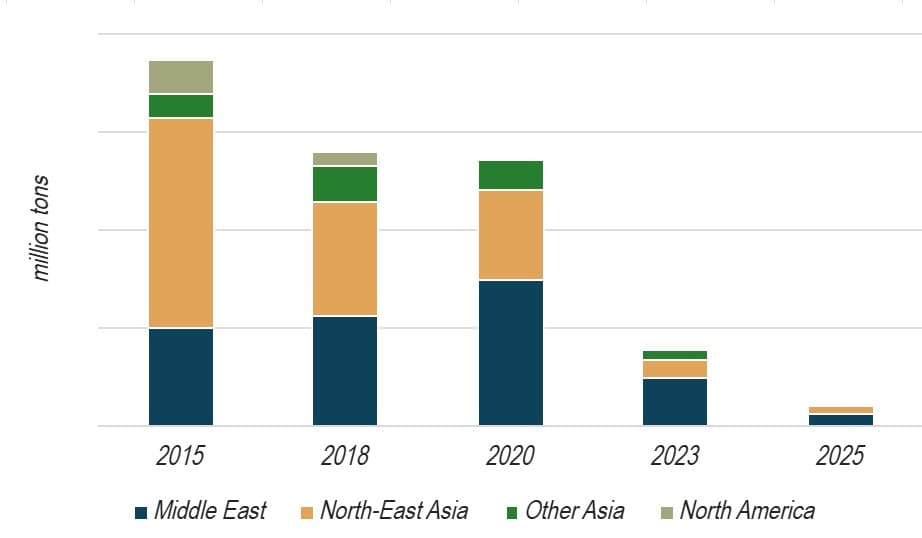
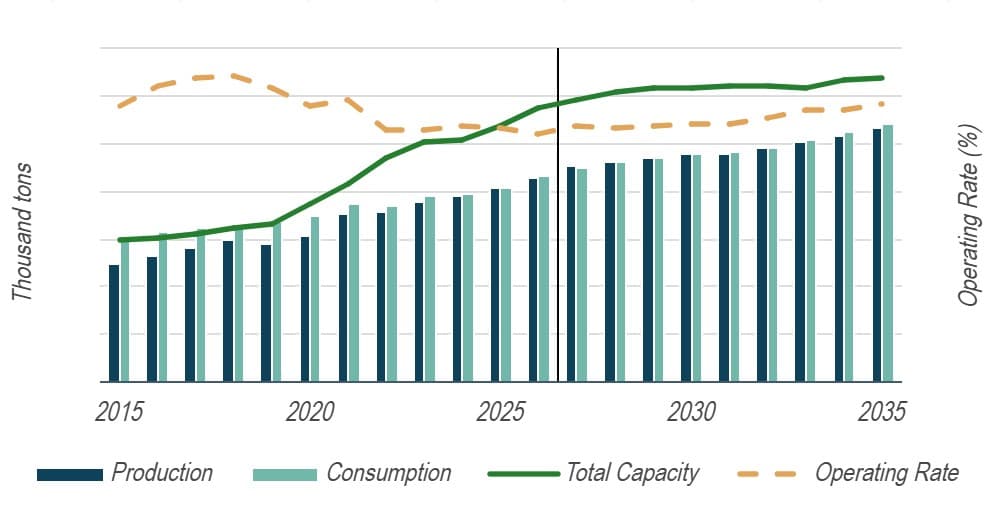
While China is expected to maintain its position as a small net importer of styrene with stable demand growth and a slowdown in capacity developments in the near future, the shear quantity of styrene imports into China has gradually been displaced by improving self-sufficiency as shown in the figure above. This reduction in dependence on styrene imports from neighbouring countries has resulted in reduced operating rates to unsustainable levels for other North-East Asian countries. However, the Middle East is the single largest region impacted by China’s improving self-sufficiency as exports to China declined 90 percent from 2020 level. Despite rapid capacity expansion, China is not projected to become a net exporter of styrene due to expected domestic benzene shortages with China remaining a significant benzene net importer. Styrene competes with other benzene derivatives that also faces large capacity additions in the near future.
Figure 1.2 North-East Asia Styrene Supply, Demand and Trade
(Source: FGE NexantECA)
How Major APAC Players are Reacting
South Korea
South Korea has seen capacity closures of close to 700 000 tons for styrene monomer, with polystyrene and EPS also seeing closures in recent years. In 2025, the Korean government led a restructuring programme with major petrochemical companies in the country, requiring these major petrochemical companies to collectively reduce production output and consolidate facilities. A state-backed financial and tax relief support is expected to be provided by the government for targeted companies. These closures are necessary for the operating rates of styrenics, in addition to other ethylene derivatives in the market to reach a more sustainable level. According to South Korea’s Ministry of Trade Industry and Energy in late 2025, this restructuring has been reported to target around three to four million tons per year of cracker capacity. FGE NexantECA anticipates that the consolidation plan is likely to remove around ten percent of the nation’s styrene capacity by 2030 as domestic ethylene feedstock is being removed from the market. While no new consolidation deals have been announced directly in response to the conflict in Iran, the resulting feedstock disruptions and cost pressures are likely to accelerate South Korea’s ongoing petrochemical restructuring. LG Chem has announced temporary shutdown of a naphtha cracker at its Yeosu complex due to feedstock shortage following the conflict in Iran, but this has not been announced to be a permanent shut down as part of the nation’s cracker restructuring plan. However, Lotte Chemical Corp. has expressed interest in higher value derivatives such as the acrylonitrile butadiene styrene (ABS) business, with a recent capacity addition in 2023 as well as polycarbonate. In addition, South Korea’s industry ministry is planning to ban the stockpiling of petrochemical feedstocks including naphtha derivatives (ethylene, benzene, etc.) to stabilise the supply chain. In the short term however, prices of styrene and its derivatives are likely to firm due to supply shortage rather than being demand driven.
Japan
Similarly, Japanese producers have also been facing similar challenges due to weakening domestic demand as it approaches maturity as well as constrained export opportunities to China. Late 2025, Asahi Kasei, Mitsubishi Chemical, and Mitsui Chemicals have formed a limited liability partnership to consolidate and downsize their collective manufacturing facilities. In addition, ENEOS is considering shutting down one of its two ethylene crackers in Kawasaki by 2027, and Idemitsu is also potentially scrapping its cracker in Chiba by 2028 which would likely result in domestic styrene capacity following suit as ethylene is a feedstock for styrene production. There has also been a strategic shift, moving the industry away from conventional basic chemicals towards higher value specialty and green chemicals as Japan is unable to compete with China’s scale. INEOS has successfully commercialised bio-polystyrene in 2025 and is being used in food trays. Other efforts that have shown potential include Idemitsu Kosan’s bio-styrene monomer production at its Chiba complex. This bio-Styrene monomer can then be used as a precursor to other bio-attributed derivatives. In addition, a shift towards high-performance styrene production from Denka such as MS Resins (a transparent copolymer made of methyl methacrylate and styrene monomer) and Isophthalic Polyester Resins used in high-tech optics. These efforts demonstrate a diversification from general-grade styrene and derivatives where the threat of China’s scale is more muted.
Taiwan
Taiwan on the other hand, is pursuing an expansion of production overseas. For example, Chi Mei has started up a 350 000 tons per year polystyrene plant in China in 2023, while FCFC has also been operating a 200 000 tons per year plant in China. This enables Taiwanese firms to benefit from low-priced styrene monomer feedstock in China. However, this comes at the expense of domestic Taiwanese capacities potentially shutting down as production in Taiwan would be less competitive than its overseas production in China. Taiwan’s New Southbound Policy (NSP) demonstrates government participation through tax incentives and other mechanisms in moving away from dependence on exports to China, focusing on R&D works in Taiwan, manufacturing in South-East Asia, and sales in the Western market.
Conclusion
As modern world-scale highly integrated complexes based in China reshape the landscape for petrochemicals, regional players are forced to adapt in order to remain afloat. This could be in the form of consolidation between major petrochemical players, diversification into higher-value specialised derivatives, or expansion into lower cost base.
For more information…
Market Analytics: Styrene - 2025
Analysis and forecast of supply and demand of the styrenics industry. This analysis will identify the issues shaping the styrene industries as well as provide detailed demand, supply and net trade data with forecasts to 2050.
Market Analytics: Polystyrene and Expandable Polystyrene - 2025
Analysis and forecast of supply and demand of the styrenics industry. This analysis will identify the issues shaping the polystyrene and expandable polystyrene industries as well as provide detailed demand, supply and net trade data with forecasts to 2050.
Author
Ian Lee, Senior Analyst, Consulting
About Us - FGE NexantECA is the leading advisor to the energy, refining, and chemical industries. Our clientele ranges from major oil and chemical companies, governments, investors, and financial institutions to regulators, development agencies, and law firms. Using a combination of business and technical expertise, with deep and broad understanding of markets, technologies, and economics, FGE NexantECA provides solutions that our clients have relied upon for over 50 years.
Contact a member of our team to see how we can support your operational, investment, or trading decisions